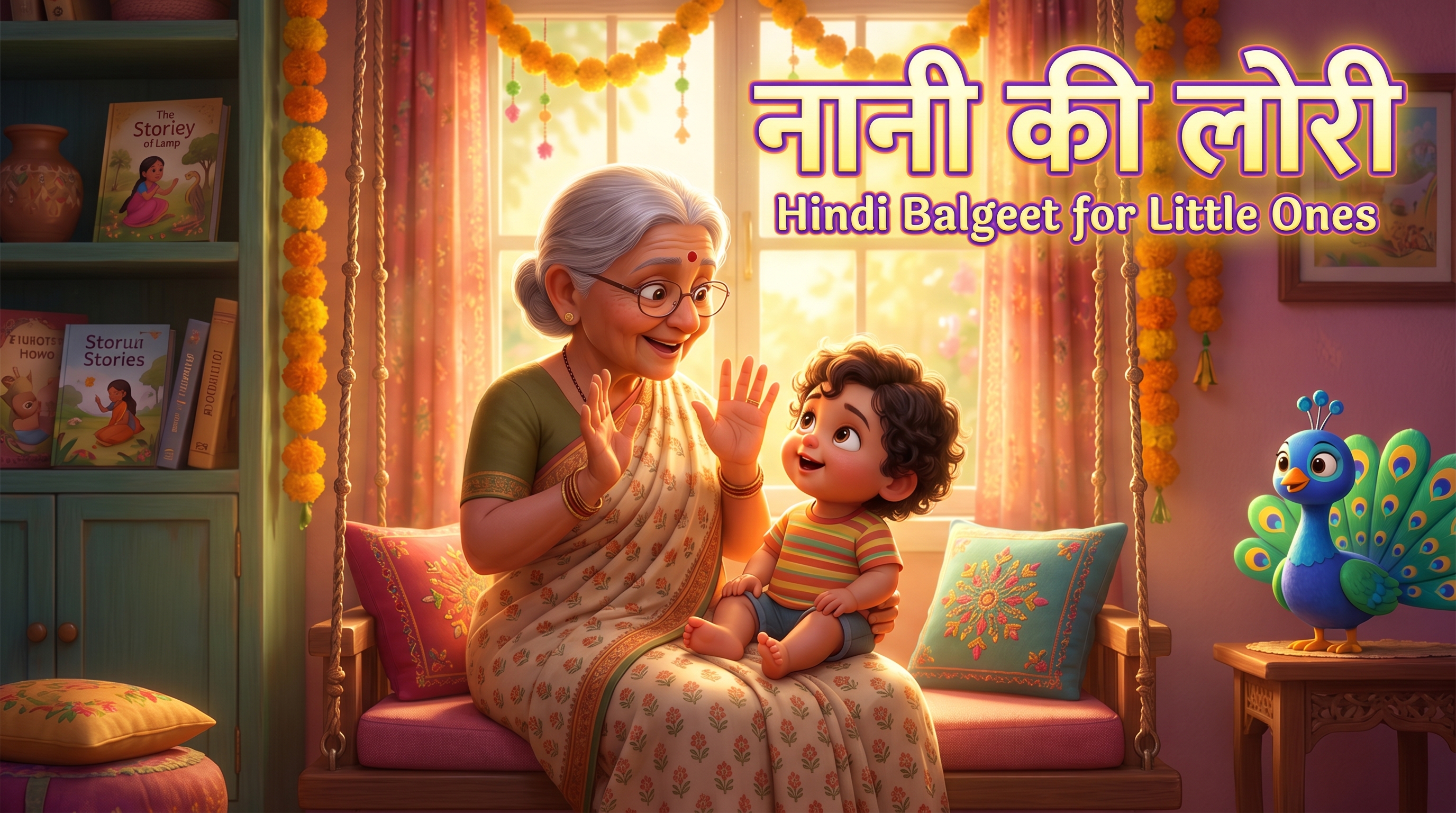
A balgeet (बालगीत) is a Hindi children’s song — a living tradition of melodies, rhymes, and lullabies that Indian families have sung to their little ones for centuries. The word itself tells you everything: bal means child, and geet means song. Together they describe a rich category of music that has carried Hindi language and Indian values from generation to generation, one bedtime at a time.
If you have ever heard a grandmother sing Chanda Mama Door Ke to a sleepy toddler, or watched a room full of children gallop to Lakdi Ki Kathi, you have witnessed balgeet in action. They are deceptively simple — short, repetitive, easy to hum — and that simplicity is precisely what makes them powerful.
What Does Balgeet Mean?
The term balgeet is an umbrella that covers all songs intended for young children in Hindi. This includes:
- Lori — lullabies sung to help babies and toddlers sleep (e.g. Lalla Lalla Lori, Chanda Mama Door Ke)
- Kriya geet — action songs that get children moving, clapping, and pointing (e.g. Lakdi Ki Kathi, Hathi Raja)
- Prakriti geet — nature songs about animals, rivers, the moon, and the seasons (e.g. Machli Jal Ki Rani, Chidiya Rani)
- Katha geet — story songs that follow simple narratives (e.g. Nani Teri Morni, Billi Chuhe Ki Kahani)
- Ganana geet — counting and alphabet songs that introduce early numeracy and literacy
Most classic balgeet blend several of these elements. Aloo Kachaloo is both a call-and-response action song and a gentle story about a mischievous child. Chanda Mama Aao Na is a lullaby that doubles as a nature song. The categories overlap, and that richness is part of what makes balgeet so replayable.
Balgeet vs. Lori: What’s the Difference?
This is the question most parents ask first. The short answer: a lori is a type of balgeet, not a separate tradition.
A lori is specifically a sleep song — slow, gentle, rhythmic, designed to ease a child from wakefulness into sleep. Lalla Lalla Lori and Chanda Mama Door Ke are the two most well-known lori in the Hindi tradition. They share a rocking, repetitive quality that mimics the rhythm of being held and swayed.
A balgeet can be a lori, but it can also be loud, fast, and energetic. Lakdi Ki Kathi — with its galloping horse rhythm — is unmistakably a balgeet and unmistakably not a lori. Understanding the distinction helps parents choose the right song for the right moment: a lori at bedtime, a kriya geet at playgroup.
The History of Hindi Balgeet
Balgeet predate recorded media by centuries. Before radio, television, or the internet, they were the primary way Indian mothers, grandmothers, and nannies transmitted language, culture, and values to young children. Songs like Chanda Mama Door Ke and Nani Teri Morni are documented in oral traditions going back generations, though their exact origins are impossible to trace.
The golden age of recorded balgeet came in the mid-20th century, when All India Radio began broadcasting children’s programming. Songs like Lakdi Ki Kathi (from the 1983 film Masoom) crossed from films into nurseries, becoming standard balgeet that every Indian child knows. The film connection is uniquely Indian — many of the most beloved balgeet began as movie songs and then became cultural fixtures.
Today, balgeet live on YouTube, in animated series, on children’s apps, and on platforms like Qissa that pair traditional lyrics with Hinglish transliterations and modern visuals. The songs themselves have barely changed; the screens that carry them are new.
Classic Balgeet Every Indian Child Should Know
If you are building your toddler’s balgeet repertoire, start here:
- Chanda Mama Door Ke — the quintessential moon lullaby; perfect for bedtime
- Lakdi Ki Kathi — a galloping action song; great for daytime energy
- Aloo Kachaloo — a call-and-response classic; fun to sing with grandparents
- Machli Jal Ki Rani — a two-line nature rhyme; easy for very young toddlers
- Nani Teri Morni — a story song; beloved by generations of Indian families
- Lalla Lalla Lori — the classic lori; still the most sung bedtime song in India
All six are available on Qissa with bilingual Hindi and Hinglish lyrics, so parents who are more comfortable reading in English script can sing along with confidence.
Why Balgeet Matter for Diaspora Families
For Indian families living outside India, balgeet carry a weight that goes beyond language learning. They are one of the few cultural traditions that travel completely intact — no special ingredients, no special occasion, no Hindi-medium school required. Just a parent, a child, and a song that Nani used to sing.
Research on heritage language learning consistently shows that music is one of the most effective transmission tools available to diaspora families. Songs create emotional memories. A child who hears Chanda Mama at every bedtime will associate Hindi with safety, warmth, and closeness — an association that makes future language learning far easier and more motivated.
Balgeet also give diaspora children a natural conversation bridge with grandparents in India. When a child in London or New Jersey can sing Aloo Kachaloo on a video call with their Nani, the connection is immediate and joyful in a way that no language lesson can replicate.
Start Exploring Balgeet Today
The beautiful thing about balgeet is that you do not need to be a trained singer, a fluent Hindi speaker, or even particularly musical to share them. You just need to know the melody and be willing to sing it, imperfectly and often.
Qissa’s complete rhyme library has over 60 balgeet — from classic lori to action songs to story songs — with bilingual lyrics and Hinglish text so every parent can sing along with their child. Browse by language, pick a favourite, and start tonight.