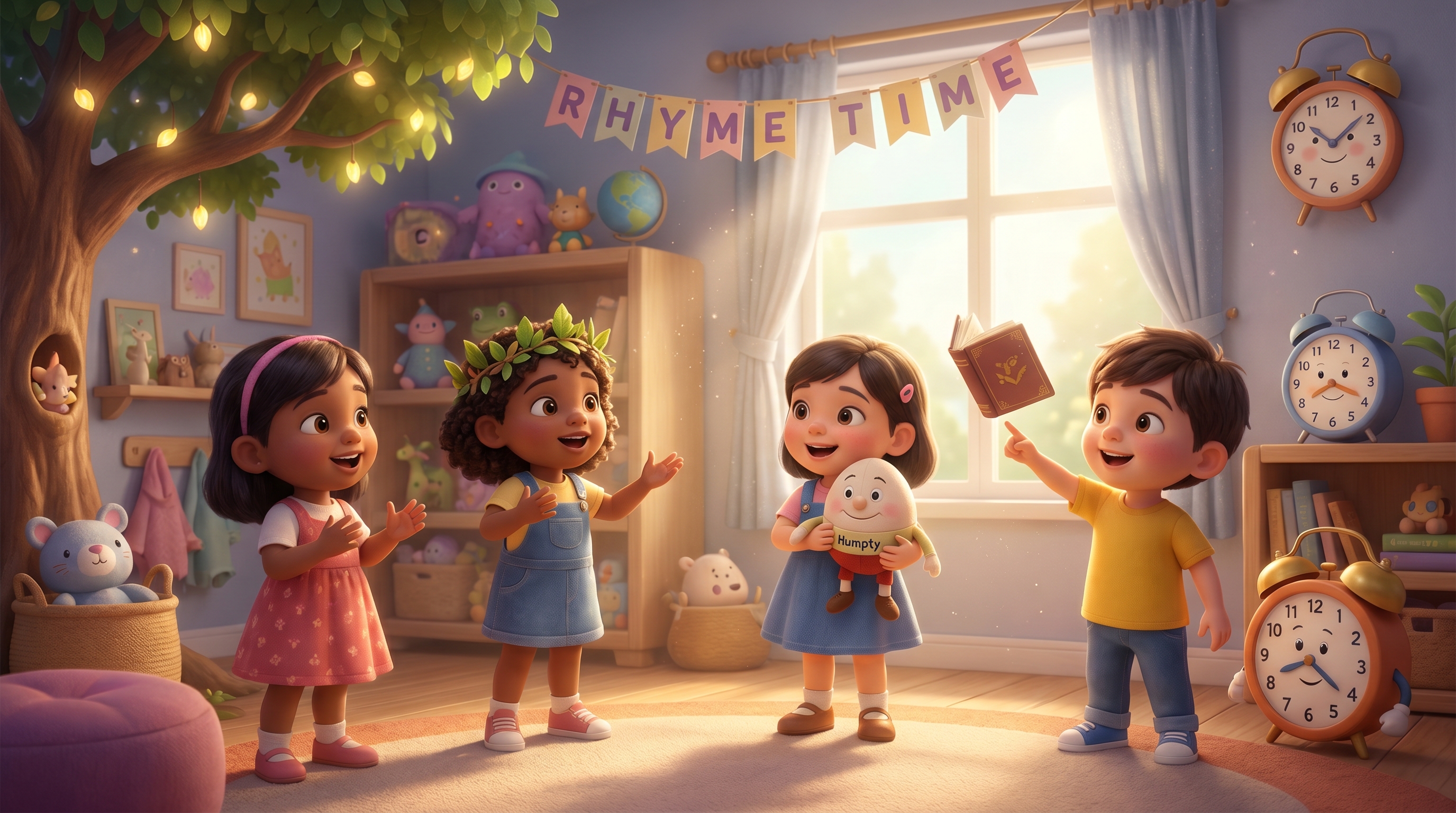
The best Hindi nursery rhymes for LKG and UKG students are ones your child can memorise quickly, perform with actions, and deliver with confidence. Machli Jal Ki Rani works for nursery class; Lakdi Ki Kathi and Nani Teri Morni are proven choices for LKG and UKG. The rule of thumb: the younger the child, the shorter the rhyme.
Indian schools introduce rhymes in the early years for good reason. Reciting rhymes in front of a class builds phonemic awareness, memory, rhythm, and public confidence — all at once. But for parents, the question is always which rhyme to choose, and how to practise it at home when you are not a Hindi teacher.
This guide breaks it down by class level so you can pick the right rhyme, find the lyrics, and have your child ready well before the school event.
What Makes a Good Rhyme for School?
Before looking at specific rhymes, here is what separates a good school rhyme from a frustrating one:
⏱ Short and repetitive wins
A 45-second rhyme performed confidently beats a 3-minute rhyme stumbled through. Young children's memory capacity is real — do not fight it.
🕺 Actions help
Rhymes with accompanying gestures (clapping, marching, pretending to ride a horse) give children something to do with their body, which reduces nerves and helps them remember the words.
❤️ Familiar is better
If your child has been hearing a rhyme at home since they were a baby, they already know it. Pick that one.
🗣️ Hindi and English both count
Most Indian schools accept both. If your child is stronger in English rhymes, do not force a Hindi one just because it sounds more impressive. Confidence matters more than language choice.
Best Hindi Rhymes for Nursery Class (Ages 3–4)
At this age, the shorter the better. Look for rhymes with no more than four lines and strong, obvious rhythm.
Machli jal ki rani hai, jeevan uska paani hai
Just two rhyming couplets. Even a 3-year-old can memorise this in a few days of practice. The fish imagery is concrete and easy to act out — swimming hands, diving motions.
Read lyrics →Aloo kachaloo beta, kahan gaye the?
A call-and-response structure that feels conversational rather than performative, which is less intimidating for shy nursery children. Parents can play the "questioner" role during practice.
Read lyrics →Chuk chuk karti gadi
For another short, repetitive choice, try this train rhyme.
Read lyrics →Twinkle twinkle, little star
For a nursery child, familiar is safe. Add the pointing-at-the-sky action and it becomes a full performance.
Read lyrics →Best Hindi Rhymes for LKG (Ages 4–5)
LKG children have slightly longer attention spans and can carry a fuller narrative. Introduce actions and movement.
Lakdi ki kathi, kathi pe ghoda
The galloping rhythm of this rhyme is almost impossible not to enjoy. Children naturally bounce and clap along. The actions write themselves — pretend to ride a horse, gallop in place. A guaranteed crowd-pleaser.
Read lyrics →Hathi raja kahan chale, haath mein leke chadi-chale
Children can swing their arms like a trunk while reciting. It is rhythmically strong and easy to project clearly.
Read lyrics →Chanda mama door ke, poova pakaye ghur ke
A slower, more lyrical choice for children who prefer calm over energetic. Suitable for children who do well with memorisation but get overexcited with action songs.
Read lyrics →Best Hindi Rhymes for UKG (Ages 5–6)
UKG students can handle a narrative arc, multiple verses, and a proper performance moment.
Nani teri morni ko mor le gaye
A story with characters, a problem, and a resolution — exactly what makes an engaging performance. This is a perennial school competition favourite across India.
Watch the animated video →Billi chuhe ki kahani sunno re
The cat-and-mouse dynamic lets children play with expression and character voices. For UKG students with a little confidence, this becomes genuinely theatrical.
Watch the animated video →Titli rani kho gayi, bagiya se woh door gayi
A gentle problem-and-resolution story that gives children concrete garden vocabulary and a clear ending.
Watch the animated video →Akkad bakkad bambe bo, assi nabbe poore sau
A counting rhyme with punchy rhythm that sounds impressive when delivered clearly. Children love the nonsense words and so do audiences.
Read lyrics →How to Practise at Home
The biggest mistake parents make is practising only the words and forgetting the delivery. Here is a simple home routine:
Listen first
Play the rhyme on Qissa with your child for 2–3 days before asking them to repeat anything.
Break into lines
Learn one line at a time, adding actions for each.
Add the audience
Perform to a soft toy, grandparent on video call, or sibling. The small real performance reduces fear.
Use Hinglish lyrics
If you cannot read the Hindi script, every rhyme on Qissa's library page has Hinglish transliteration so you can guide your child accurately.
The goal is not perfection — it is a child who walks to the front of the class, smiles, and speaks clearly. That is a win at any age.