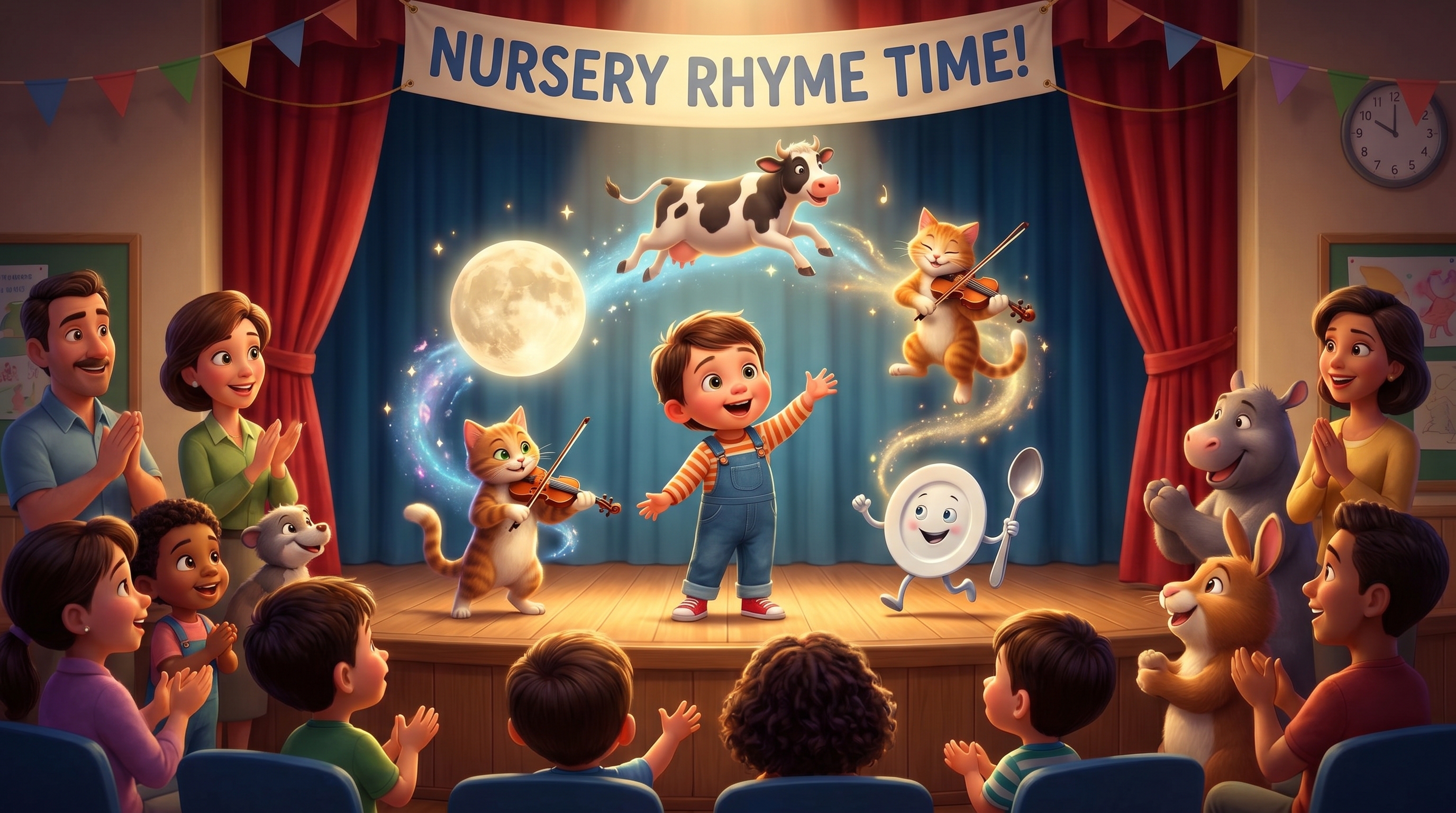
The best nursery rhymes for school competitions are the ones your child can deliver with confidence, not just recite correctly. Lakdi Ki Kathi wins on energy; Nani Teri Morni wins on storytelling; Humpty Dumpty wins on brevity and clarity. The golden rule: pick a rhyme your child already loves, add actions, and practise it until the words come automatically — because on stage, nerves will take over and only automatic recall holds.
Indian school rhyme competitions — whether called elocution, recitation, or just “rhyme day” — are a fixture from nursery class to UKG. They are one of the first public performances most children ever give. Picking the right rhyme and preparing it properly makes an enormous difference to how that experience lands.
What Makes a Competition Rhyme Work?
Not every rhyme that sounds good on YouTube will work on a stage. The best competition rhymes share these qualities:
Strong, obvious rhythm. The rhythm should be so clear that the child feels it in their body as they speak. Lakdi Ki Kathi and Humpty Dumpty both have this — you almost cannot say them without bouncing.
Short enough to memorise completely. “Completely” means the child could recite it in their sleep, not just when prompted. Under-memorised rhymes fall apart under stage anxiety. If the child needs reminding at home after two weeks of practice, the rhyme is too long.
Natural action opportunities. Actions give the child something to do with their hands and body, which absorbs nervous energy and makes the performance visually engaging. A still child standing with hands at sides is harder to watch than a child who gallops, waves, or points.
Known to the audience. Classic rhymes resonate with parents and teachers who recognise them. A judge who knows Nani Teri Morni will smile from the first line. An obscure rhyme, however well-performed, has to earn its audience from scratch.
Best Hindi Rhymes for School Competition
Lakdi Ki Kathi (Lakdi ki kathi, kathi pe ghoda) Age: Nursery to UKG · Duration: ~40 seconds
The most reliable competition rhyme in India. The galloping rhythm is irresistible, the vocabulary is simple, and the horse-riding action is universally understood. Even a nervous child can deliver this one — the rhythm carries them. Suitable for all age groups from nursery upward.
Nani Teri Morni Ko Mor Le Gaye (Nani teri morni ko mor le gaye) Age: LKG to UKG · Duration: ~90 seconds
A generational favourite. Every Indian parent and teacher in the audience will recognise this rhyme within the first two words, which creates instant warmth. The story structure — someone’s peacock is stolen, consequences follow — gives a confident child room for expression and character. Best for LKG and UKG students who have memorised it thoroughly.
Aloo Kachaloo Beta Kahan Gaye The (Aloo kachaloo beta, kahan gaye the?) Age: Nursery to LKG · Duration: ~45 seconds
The call-and-response structure is unusual in competition settings — it makes the performance feel interactive even when the child is performing solo. The nonsense food names (aloo, kachaloo) always get a laugh from the audience, which relaxes both child and parent. A great choice for extroverted children who enjoy the crowd’s reaction.
Akkad Bakkad Bambe Bo (Akkad bakkad bambe bo, assi nabbe poore sau) Age: LKG to UKG · Duration: ~35 seconds
Short, punchy, and rhythmically perfect. The counting sequence gives it a satisfying arc. For children who struggle with longer rhymes, this is an excellent choice — it is over quickly, the rhythm is strong, and it ends on a clear number that feels like a conclusion.
Best English Rhymes for School Competition
Humpty Dumpty Sat on a Wall Age: Nursery to LKG · Duration: ~25 seconds
Famously short and widely known. A child who delivers this clearly and confidently, with a sad face at the “great fall” and a shrug at “couldn’t put Humpty together again”, will get a round of applause every time. The emotional arc in four lines is remarkable.
If You’re Happy and You Know It Age: Nursery to LKG · Duration: ~60 seconds
The clapping and stomping actions are built into the rhyme, which makes this the lowest-stress competition choice for very young or very shy children — the actions guide the performance. A child who forgets a word can clap, and the audience claps with them.
Jack and Jill Went Up the Hill Age: Nursery to UKG · Duration: ~30 seconds
A complete story in four lines. For children who can commit to a tumbling action at “Jack fell down”, this becomes a miniature play. Simple vocabulary, strong narrative, universally known.
Head, Shoulders, Knees and Toes Age: Nursery · Duration: ~45 seconds
The best choice for very young children who are not yet confident standing still on stage. The required pointing actions give them constant direction, and the audience naturally mirrors the movements — creating an immediate connection between performer and crowd.
Practising for the Big Day
Start three weeks before the competition. Week one: memorise the words. Week two: add the actions. Week three: full run-throughs with an “audience” (a toy, a grandparent on video call, a sibling).
Record a practice run. Children behave differently when they know they are being recorded — it mimics the feeling of performing. Watch it back together and focus on one thing to improve, not everything at once.
On the day: keep it calm. Over-drilling on the morning of the competition creates anxiety without improving performance. A single confident run-through in the morning is enough. Then trust the weeks of practice.
All the rhymes above are in Qissa’s library with full lyrics, Hinglish transliterations, and animated videos. Find your child’s rhyme, learn the words, and practise the actions — the confidence will follow.