The best bilingual songs for Indian children growing up abroad are the ones that appear in both family life at home and in the English-speaking world outside — rhymes like Twinkle Twinkle Little Star, which exists in both an English original and a beautiful Hindi version, and Johny Johny Yes Papa, which has been sung in Hindi kitchens and English nursery schools alike. These bridge songs are the most powerful tools available to diaspora parents, because a child who knows both versions of a song is genuinely bilingual in that small, concrete way.
Building a bilingual song repertoire is one of the most practical things an Indian family abroad can do for their child’s language development — and it requires nothing more than a phone, a bit of time, and a willingness to sing the same songs over and over.
What Makes a Song “Bilingual” for Indian Kids?
There are three types of bilingual songs useful for Indian families:
1. Rhymes with Hindi and English versions on the same page. Qissa offers several of these — rhymes like Twinkle Twinkle Little Star and Incy Wincy Spider that have both original English lyrics and a Hindi version with Hinglish pronunciation guide. A child can learn both versions of the same melody, which doubles the vocabulary anchored to a single tune.
2. Hindi rhymes with English meaning translations. Every Hindi rhyme on Qissa now includes an English meaning tab, so a child (or parent) can understand what the Hindi words mean. This makes a rhyme like Chanda Mama Door Ke bilingual in a different sense — the child learns chanda means moon, mama means uncle, door means far away. The vocabulary transfers.
3. Rhymes known in both cultural contexts. Johny Johny Yes Papa is sung in Indian homes and classrooms around the world. When your child sings it in both English and Hindi, they are using language that works equally in a London nursery and on a video call with grandparents in Pune.
The Best Bilingual Rhymes for Diaspora Families
Twinkle Twinkle Little Star The most universally known lullaby in the English-speaking world also has a rich Hindi version about twinkling stars. Teach both versions from infancy. When your child hears Twinkle Twinkle at their English nursery school, they will have an immediate Hindi connection at home. When they sing the Hindi version with Nani, they share the same melody both languages know.
Johny Johny Yes Papa This is one of the rare rhymes that is genuinely culturally Indian and globally popular simultaneously — thanks to its viral English version, it is known worldwide. The Hindi version (Johny Johny, haan Papa, cheeni khana, nahi Papa) is the original. Teaching both versions gives a child a song that works in every context.
Machli Jal Ki Rani Hai Two lines in Hindi, instantly memorable, with a clear English meaning (Fish is the queen of water, water is her life). The shortness makes it a perfect first bilingual rhyme — a child can learn both versions in an afternoon. Use it at bathtime in both languages.
Incy Wincy Spider The spider who climbs up the water spout is known at every English playgroup. Qissa’s bilingual version gives it a Hindi parallel. Teaching both means your child has this song in two languages — rare social capital at both an Indian family gathering and a school assembly.
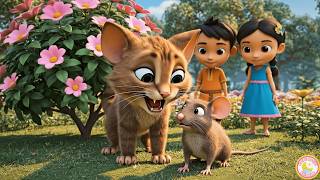
Billi Chuhe Ki Kahani This animated Hindi story of a cat and mouse becoming unlikely friends has no direct English equivalent, but the English meaning on Qissa makes the story accessible to English-dominant parents and children. It teaches narrative Hindi — not just individual words but a full story arc — in a format toddlers love.
Songs That Grandparents Will Recognise
For diaspora families, the moment a grandparent on a video call lights up with recognition is worth more than any formal language lesson. The rhymes most likely to create that moment:
- Chanda Mama Door Ke — known by grandparents across every region of India
- Nani Teri Morni — especially powerful when sung with Nani present
- Lakdi Ki Kathi — the galloping horse rhyme, a cross-generational favourite
- Aloo Kachaloo Beta — call-and-response that grandparents will immediately continue
These are not just songs. They are shared cultural references that let a child in Toronto have a genuine conversation — through music — with a grandmother in Jaipur.
How to Build a Bilingual Song Playlist
The most effective approach is small and consistent rather than large and occasional.
Morning playlist (in the car, while getting dressed): Two upbeat rhymes — one Hindi, one English. Rotate from a pool of six to eight songs so neither parent nor child gets bored, but each song is heard frequently enough to be memorised.
Bathtime: One short Hindi rhyme, always the same one. Machli Jal Ki Rani for a fish-in-water association. This becomes automatic within weeks.
Bedtime: One Hindi lori, then one English lullaby. Lalla Lalla Lori into Twinkle Twinkle, or Chanda Mama Door Ke into Are You Sleeping. The sequence becomes a sleep cue.
Video calls with grandparents: Teach one grandparent-recognisable Hindi rhyme per month. Before each call, do a quick sing-through with your child. The shared moment is worth the five minutes of preparation.
All 66 rhymes — with Hinglish lyrics, English meanings, and printable lyric sheets — are at Qissa’s library. Find the ones your family returns to, and let them become the soundtrack of your child’s bilingual childhood.